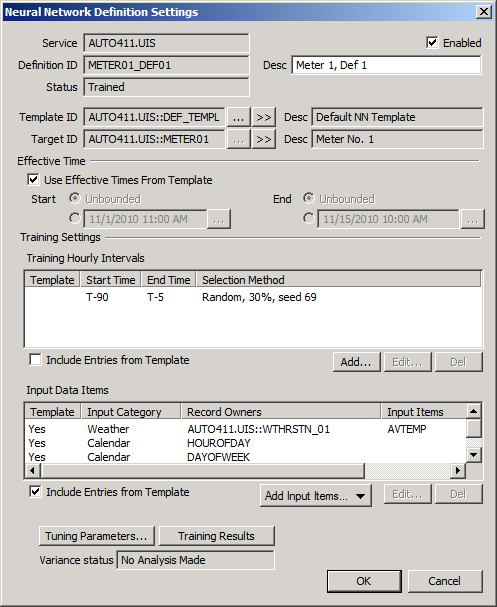
Use the Neural Network Definition Settings dialog box to configure the settings for the selected neural network definition. Many settings are inherited from the associated neural network template and may be overridden for the individual neural network definition.
The neural network definition combines the attributes of the associated neural network template with the historical and forecast data associated with a specific meter or meter group. More than one neural network definition may be associated with the same neural network template and meter or meter group as long as the effective time intervals are unique and non-overlapping.
In order to perform the training and forecasting function for qualified meter or meter group, a neural network definition with a forecast time interval that covers the specific time interval for which the forecast must be generated must exist in the system.
To Configure Neural Network Definition Settings
The properties on the Neural Network Definition Settings dialog box are described below.
| Parameter | Description |
|---|---|
|
Service |
Specifies the CVS service where the neural network definition facilities are maintained. |
|
Enabled |
Click to enable or disable the neural network definition. |
|
Definition ID |
Specifies the Facility ID of the neural network definition. |
|
Desc |
The Description value associated with neural network definition. |
|
Status |
Indicates the status of the neural network definition and training. The states include: Untrained, Waiting to Train, Training, Training Error, Training Canceled, Pending Approval, Trained, and Config Changed (the trained state is inconsistent with the configuration state). |
|
Template ID |
Specifies the ID of the associated neural network template. Click … to select a defined neural network template. Click >> to see the configuration settings for the associated neural network template in read-only mode. |
|
Desc |
The defined description for the associated neural network template. |
|
Target ID |
Specifies the ID of the associated target meter or meter group from which historical and forecast input data will be retrieved for the training and forecasting. Click … to select a defined meter or meter group. Click >> to see the configuration settings for the associated meter or meter group in read-only mode. |
|
Desc |
The defined description for the associated meter or meter group. |
Specify the time interval for which this neural network definition is applicable. Accept the values from the associated neural template or override the values as necessary.
| Parameter | Description |
|---|---|
|
Use Effective Times from Template |
Select to use the effective times for this neural network definition from those defined for the neural network template. Or override with different values. |
|
Start |
Select Unbounded or select a specific start time. Click … to set a Start Hour for the effective time for the neural network template from the Choose Date and Time dialog box. |
|
End |
Select Unbounded or select a specific end time. Click … to set an End Hour for the effective time for the neural network template from the Choose Date and Time dialog box. |
The table lists the historic training intervals in the past over which all historical data, gas load as well as input data, must exist in order to execute the training process for this neural network definition. Training intervals may be specified as a fixed interval or for a time interval that is relative to the current time. Also configurable is the selection method for the historical data used for training. Accept the values from the associated neural template or override the values as necessary.
| Column or Button Name | Description |
|---|---|
|
Indicates if the training interval settings have been inherited from the associated neural network template. |
|
|
Start Time |
Specifies the start time of the training hourly interval. |
|
End Time |
Specifies the end time of the training hourly interval. |
|
Selection Method |
Specifies the selection method of the training hourly interval. |
|
Include Entries from Template |
Select to include the training hourly intervals from the neural network template. |
|
Add |
Click to add a new training hourly interval. |
|
Edit |
Click to edit an existing training hourly interval. See Configuring Training Interval Settings. |
|
Del |
Click to delete an existing training hourly interval. |
The table lists the input data items required to both train the neural network and generate load forecasts (once the template is associated with a specific meter or meter group and becomes a definition). Accept the values from the associated neural network template or override the values as necessary.
| Column or Button Name | Description |
|---|---|
|
Template |
Indicates if the input data items settings have been inherited from the associated neural network template. |
|
Input Category |
Specifies the Input Item Categories to be used as inputs to this neural network. Options include: Input Category Item, Calendar, and Gas Load. |
|
Record Owners |
Specifies the Record Owner or Record Owners Group IDs whose data items will be used as inputs to this neural network. |
|
Input Items |
Specifies the Input Data Item type(s) associated with each Input Data Item to be used as inputs to this neural network. |
|
Include Entries from Template |
Select to include the input data items settings from the neural network template. |
|
Add Input Items |
To add an Input Item click Add Input Item and select the desired Input Data Item: Input Data Item, Calendar Item or Gas Load Item. See Configuring Input Data Items. |
|
Edit |
Select an Input Data Item and click Edit to modify its properties. See Configuring Input Data Items. |
|
Del |
Click Del to delete an Input Data Item. |
Click Tuning Parameters to specify necessary tuning parameters required by the neural network training algorithm for this neural network definition. Accept the values from the associated neural template or override the values as necessary. See Configuring Tuning Parameters.
Click Training Results to view the training results for this neural network definition. See Viewing Training Results.
The variance analysis process adds retraining tasks to the training priority queue for neural network definitions whose forecasts are not within an acceptable range of the actual gas load. The status of the variance analysis process for the last training session is shown at the bottom of the Neural Network Definition Settings dialog box. Possible states include: No Analysis Made, Needs Retraining, and Within Threshold.
More:
 Configuring Training Interval Settings

|
|
|

